Rising Stars Need a Witness
Cosign aims to make overlooked talent easier to find
Someone believed in me
In 2018, Jon Gosier sent me a message saying he was going to introduce me to Bob Moore. I did not ask for an intro, but I damn sure earned it.
I was the second engineer hired at Audigent, a company Jon co-founded in Philly back in 2015. When I started, we were living off a small friends-and-family round, with less than six months of runway before the money ran out. I was all in. 60-70 hour work weeks, heated but respectful debates, and an obsession with making our MVP demo well. Jon saw it all.
We survived and Audigent was later acquired by Experian for $363 million.
Bob Moore, the CEO of Crossbeam, was a bit of a legend in the Philly startup ecosystem. Getting a meeting with him was a “cancel all your plans” type of situation. Jon’s intro got me an interview and laid the foundation for a senior engineering role.
I had the talent, and I was ready. But being talented and prepared often isn’t enough. Many of us stay ready. We’re hungry. But you need someone to believe in you and mention your name when you’re not in the room. Jon did that for me. He was my first professional “cosigner” in tech.
Cosigns are expensive, and they are earned
When I hear the word cosign, I’m reminded of all the apartments in Boston I couldn’t get into during my college days without help from my parents. I think about the seriousness of the cosigner commitment for mortgage and loan applications. A cosigner is making a legally binding promise. If you can’t pay, they will, or their credit score goes down the toilet with yours.
Being a legal cosigner is no joke. A recommendation or professional cosign for a former coworker won’t put your credit score at risk, but your name is still attached to it. Cosigns are earned first, given second. I don’t want a button turning that into a casual favor, with requests blowing up my inbox.
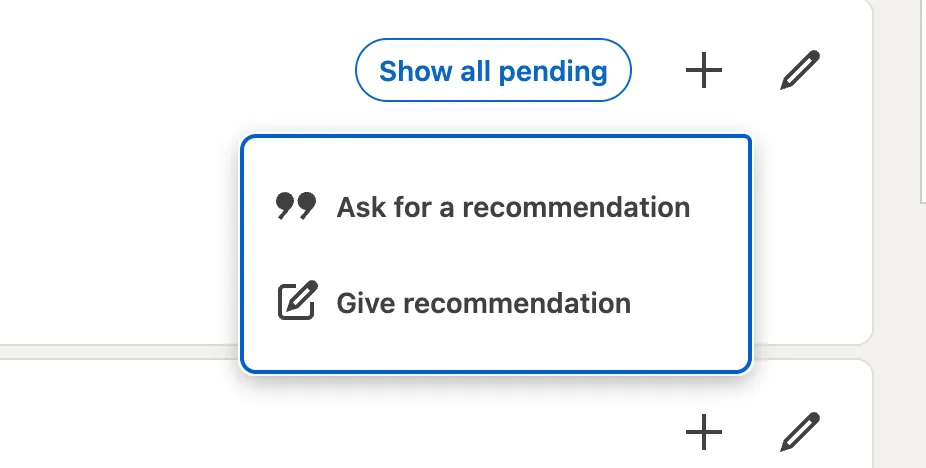
Asking for a recommendation on LinkedIn
Cosign, a new professional network from a16z’s New Media team that launched on September 25th, is built around that idea. The absence of a request button is my favorite subtle design choice in the product. I love that it doesn’t nudge users to beg for praise.
I wouldn’t fault someone for asking a former colleague to put in a word if that colleague knows their work, because the endorsement is still earned. Waiting to be cosigned is a tough strategy for someone who isn’t already well connected.
Excited to introduce @Cosign: the curated professional network for the startup community: cosign.co
— Erik Torenberg (@eriktorenberg) September 25, 2026
Our goal is to create the following:
- A comprehensive startup directory of investors, companies, and operators, including what they worked on and who they worked on it with.
- Cosign graph: Who shaped your career? Who were you actually in the trenches with? Who would work with you again? Who thinks you’re someone to watch?
- Durable reputation: Great endorsements happen every day on X and disappear into the feed. Cosign attaches those signals permanently to people and companies.
- Discovery: Who are the best fintech angels? Which AI companies should I watch? Who are the best designers?
- Intent network: Privately signal “I’d invest in them,” “I’d hire them,” “I’d work with them,” or eventually even “I’d acquire this company.” Match people when interest exists on both sides.
Imagine if Wikipedia, LinkedIn, and OG AngelList had a baby. Though Cosign is a community, not a business.
In order to join, you need to be cosigned. Or you can apply directly.
David Booth and I started this idea 7 years ago but didn’t have the firepower to make it work. Now we do.
No one has really touched LinkedIn in 20 years. Excited to take a swing.
cosign.co
When credentials get cheap
AI can polish a resume, tailor a cover letter, and build a portfolio site in an afternoon. A candidate can look great before anyone has seen them work.
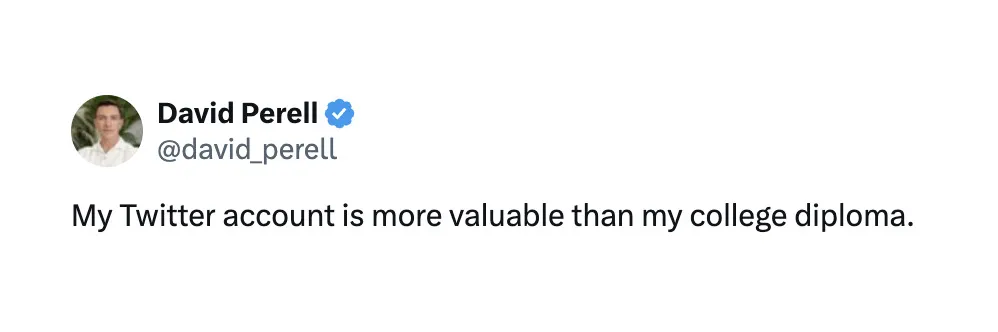
It’s really common now to check who follows them instead. Erik Torenberg, a general partner at a16z, posed an interesting thought experiment:
What's more impressive to you: someone who went to Stanford, or someone who is followed by Patrick Collison, Elon Musk, and Marc Andreessen? I think most people would say the latter. It's this kind of peer-to-peer credential.
— Erik Torenberg
Erik Torenberg on peer-to-peer credentials
An elite degree tells you something. It still doesn’t tell you what someone built last month or what they’re like to work with. Your social graph will.
David Perell, one of my favorite writers and thinkers, follows fewer than a thousand people on X. I’d love it if he followed me, but I’d never ask. How ridiculous would that be? I’d look like a clown. Still, a follow wouldn’t tell anyone why he was interested.
On Cosign, someone can explain why they’re backing you. There is of course a platform that preceded Cosign but it has become a sales and go-to-market tool first and a professional network slop machine second.
Using @pangram on LinkedIn is like seeing the AI matrix
— Lenny Rachitsky (@lennysan) October 5, 2026
Lenny spoke no lies here. My timeline over there is ridiculous.
The recommendations I’d want to read are probably sitting in private group chats or being shared in person. Cosign could make them useful to someone outside those conversations who’s looking for their next play.
My name is on the line
I’ve been giving cosigns for years.
My brother and I run Post in Black, a podcast where we’ve interviewed dozens of editors, music supervisors, sound editors, and VFX artists for the past six years. The people behind the scenes who rarely get covered. Eventually filmmakers in the industry started asking us who to hire. We’ve put our names on the line countless times.
But it doesn’t always work out.
We all have stories about referrals that went sideways. I once recommended a friend for a job on a short film, and they ended up not getting along with the producer and director. It eventually got really combative. The filmmakers hit me up and said they’d never work with my friend again. I still remember how shocked they were at the whole experience because the recommendation came from me. A trusted source.
A skeptic of Cosign wrote: “A vouch only works as a signal that is costly if giving a bad one costs the voucher something later.”
Would a stranger reading one of my cosigns ever hear about a bad referral?
If I’m wrong, should it cost something?
I’d want to look back at someone’s cosigns and see how their judgment held up. Did they spot people early? Do they seem to endorse everyone? That would affect how much weight I’d give their next recommendation.
Full disclosure: I gave my first cosign to Dhruv Gupta, one of the product engineers at Cosign. We met because I was impressed with the platform and was eager to help. I haven’t worked directly with him so I picked “Will be a Star.” It’s a bet, not a reference.
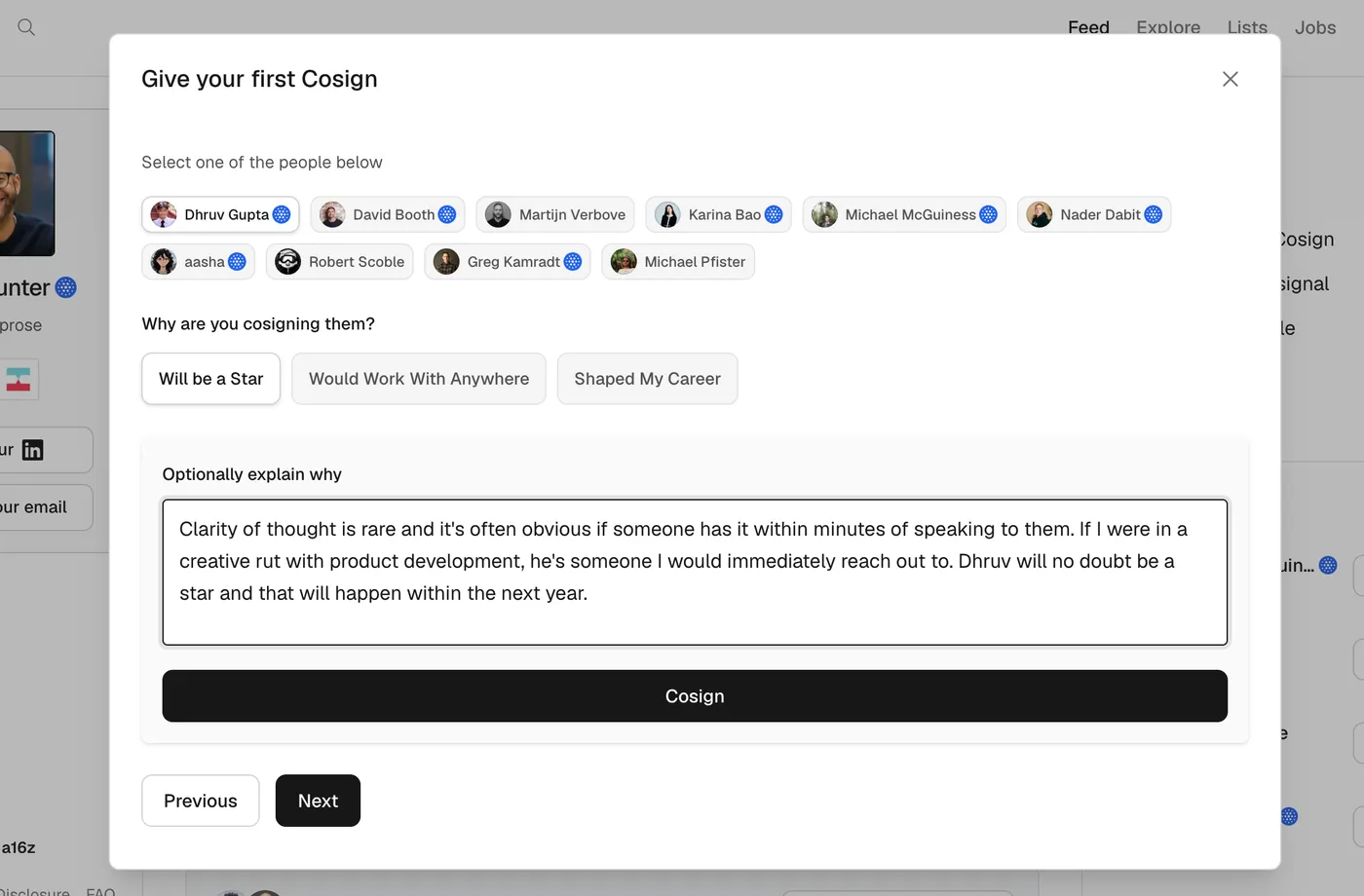
Cosign’s FAQ asks people to explain what their belief is based on, including whether they’ve worked together or followed someone’s work. I’d want that reminder while writing the endorsement.
The FAQ also says you can edit your cosigns. Good. I’d want to correct something I got wrong. But how long should someone be able to edit a cosign? And is it clear to readers that it was edited, when, and why?
Getting a prediction wrong doesn’t necessarily mean I was careless, but claiming to know someone’s work better than I did would be my fault. I wouldn’t want both judged the same way.
If every failed bet hurts your reputation, why take a chance on someone unknown? Endorsing an established name would be safer.
The good ol’ boys club and peer-to-peer credentials
The group chats and back-channel references Cosign wants to bring into the open have historically worked best for people who were already inside.
Look closely at Torenberg’s thought experiment. Being followed by Patrick Collison, Elon Musk, and Marc Andreessen is impressive precisely because almost nobody gets close enough to earn it. A credential that flows through who you know rewards the people who already know the right people. I hope the Cosign product doesn’t turn into insiders vouching for insiders, where the socially rich get richer. If it does, overlooked talent will still get overlooked.
Outsiders need more rooms where their work gets seen.
I’d love to see Cosign borrow from the Cursor (SpaceXSI?) community playbook. Local chapters, each run by an ambassador, could give people a place to demo what they’re building. Someone who sees a promising project could give its creator a “Will be a Star” cosign and explain what caught their attention. They wouldn’t need years of working together to have something specific to say.
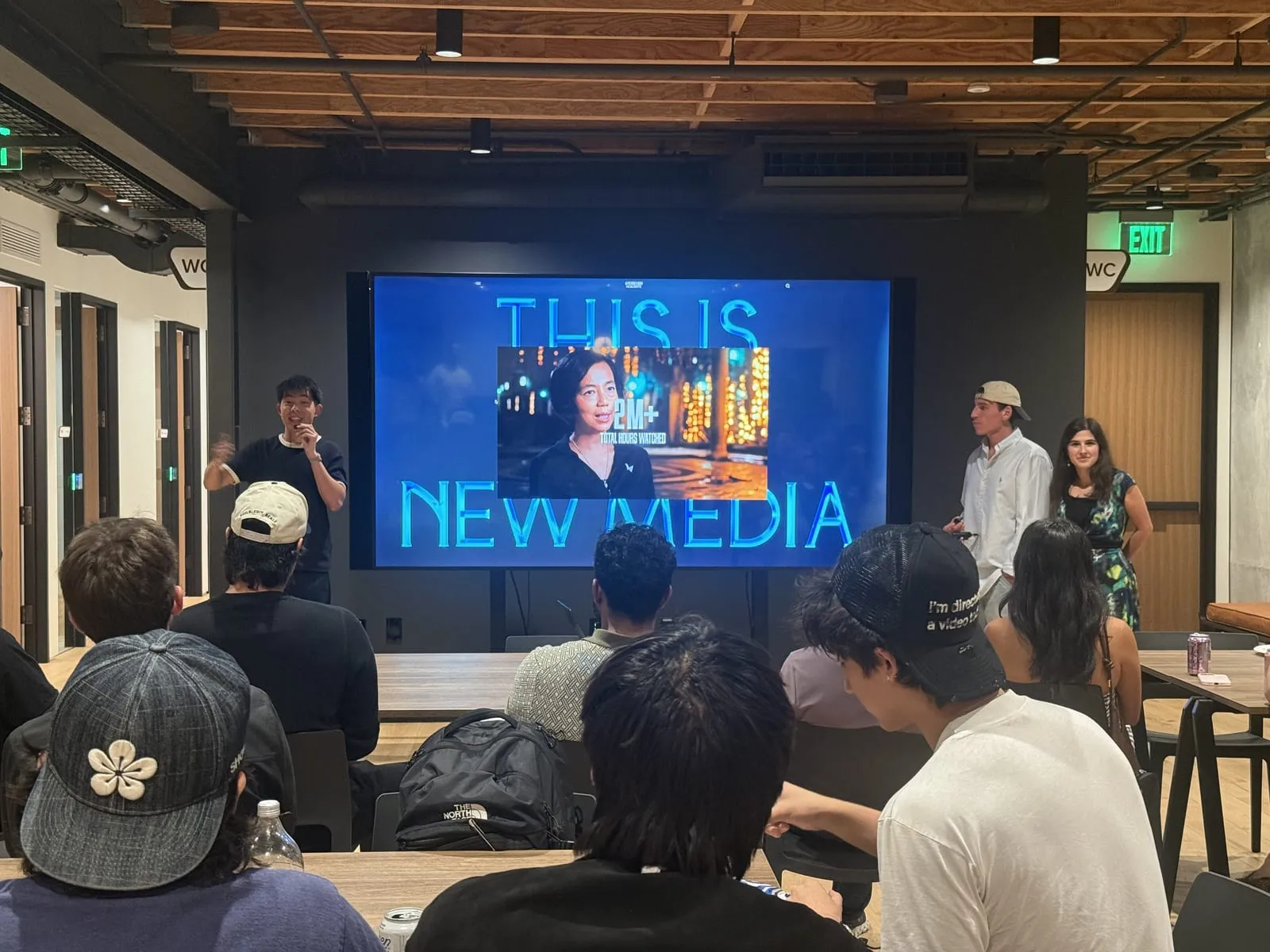
An a16z New Media event in Santa Monica
Done right, that shrinks the insider advantage and brings more hidden gems to the surface. A cosign is worth the most when it’s a new discovery for the viewer and not just a confirmation.
Fin
Jon didn’t owe me that intro to Bob, and he never asked for anything in return. He’d watched me work, and he was willing to put his name next to mine. That’s what makes a cosign worth something.
Think about who spoke for you in a room you weren’t invited into.
Think about who you could do that for.
Then put your name on the line.
— Daniel